For someone who writes technical manuals for a living, I was slow to read my own body's manual. I spent the first year of remote work hunched over a monitor that sat a few inches lower than my eyes wanted, at a desk from a previous house, with my keyboard on a tray that never felt level. My lower back, which has not fully forgiven a car accident in 2015, weighed in every afternoon. I tried the usual fixes: a lumbar cushion, a footrest, reminders to sit up straight. The reminders lasted about twenty minutes. Eventually I stopped asking my chair to solve a desk problem and added a VIVO standing desk converter to the desk I already owned. For the last six months I have split my workday between sitting and standing without buying a single new piece of furniture.
The short version is that the VIVO is a converter, not a standing desk, and that difference matters more than you might think. A converter sits on the desk you already have and lifts the monitor and keyboard when you want to stand. A full standing desk replaces the whole work surface and asks you to rethink the room. I did not want a second desk in my 10 by 11 foot office in Raleigh. I wanted my existing screen to move up and down and my keyboard to follow it, without turning the spare bedroom into a warehouse. Six months later, that is exactly what has happened. Before the long story, here is the verdict, then the details, then the parts I would only tell a friend in person.
The Quick Verdict
A steady, no-power converter that put my monitor at eye level in both positions for six months. The keyboard tier is shallow and the lift is stiff when new, but I used it every workday and I would buy it again.
Amazon Check Today's Price →Your desk may be fine. Your afternoon backache is the problem worth solving first.
This is the exact VIVO model I have used every workday for six months. Amazon's price shifts from week to week, so check today's number before you decide.
Amazon Check Today's Price on Amazon →How I've Used It
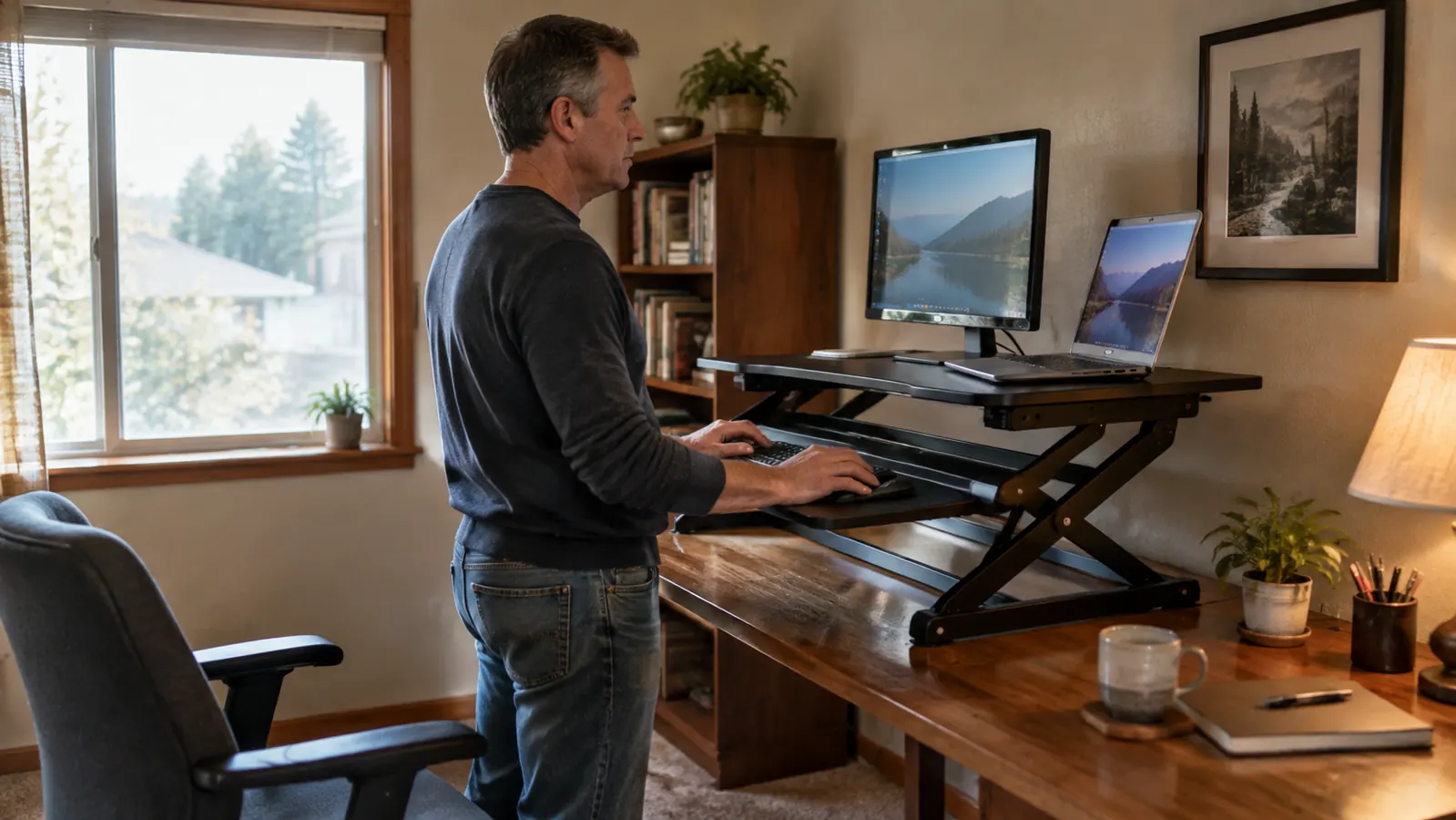
My office is a converted spare bedroom in a 1990s ranch house in Raleigh, about 10 by 11 feet, with one north-facing window to the left of the desk. The desk runs along the long wall and there is no room for a second work surface, which is why I chose a converter instead of a new standing desk. The VIVO sits in the center of my desk. My main monitor is on the upper platform, my laptop is on a stand beside it, and my wired keyboard and mouse live on the lower tier in front of me. My hands land in the same comfortable place whether I am sitting or standing, and that consistency is the quiet reason the converter has stayed.
At first I treated standing like a chore with a required minimum dose. I would set the converter up, stand for nine minutes, and feel very virtuous. By the second week I stopped timing myself. A normal day now runs like this. I sit around 8:30 with coffee and email. Mid-morning my hips send a clear message, so I release the lock under the upper platform, guide everything up until the monitor is at eye level, and stand for the next stretch. Sometimes it is thirty minutes. Sometimes it is two hours if a deadline has me in the zone. When my legs have had enough, I lower the platform and keep going. The whole switch takes about four seconds, which matters on days when I am in the middle of a sentence.
Because I take three or four video calls a week, I was also worried about the noise. The VIVO uses no motor, so there is no hum and no sudden whir. When I raise the platform during a call, my colleagues see the screen move and hear nothing. That is a small point, but it is the kind of thing that decides whether a product stays in the room or goes back.
One thing surprised me early on: I now sit differently than I did before. The VIVO adds height even at its lowest position, so I raised my chair slightly to keep my elbows at a right angle. That single change meant I stopped looking down at the screen. My neck had been complaining without my permission for about a year, and it went quiet within a few days. I did not notice exactly when it stopped, which is how most good fixes work.
What the Design Gets Right
Any converter can hold a monitor. The lower keyboard tier is where this one proves itself. It does not bounce or flex when I type, and after a full day of writing I stop noticing it, which is the highest compliment an office product can get. I do not know exactly how VIVO braced it, and I do not need to. I only know that my keyboard does not wobble and my mouse does not skate off when I hit a particularly long technical sentence.
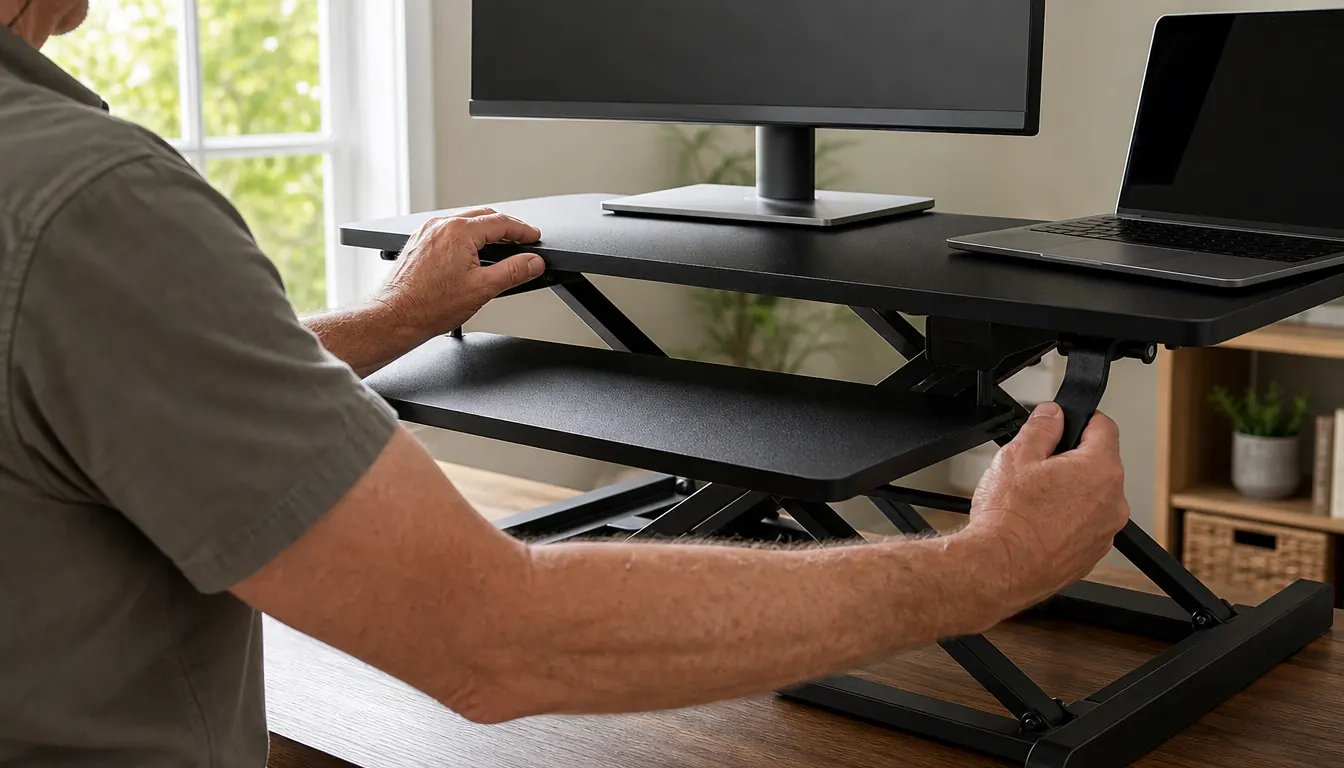
The lift is manual, which means no motor, no power cord, and no charging. I release a lock under the upper platform, guide everything up, and let it settle. The movement is more of a controlled push than an effortless float. New units are stiff, and mine was no exception, but it loosened up within the first two weeks. Now it feels predictable. Predictable matters more to me than slick.
The unit is 36 inches wide, so measure your desktop before you order. It fits comfortably on mine and sits heavily enough to stay planted. When I push against the keyboard tier while typing, the converter does not shift. That stability is the whole ballgame for a product that lives on top of another product.
Six Months of Sitting and Standing
The honest benefit after six months is not that I stand for eight hours a day. It is that I move at all. I am not a physiotherapist and I do not give medical advice, but I can tell you what changed for me. The midafternoon slump that used to end my productive stretch is now a midafternoon switch to standing. After an hour on my feet, my shoulders have uncurled, and when I sit back down, I sit differently. That is the real, unglamorous win.
One habit emerged that I did not plan. I do first drafts sitting, because my brain connects the chair with writing. Editing is a different kind of work, closer to reading, and standing makes me read more slowly and catch more awkward transitions. I did not arrange this deliberately. It showed up on its own after about three weeks and it has stayed.
The real change after six months is not how long I stand. It is that my shoulders stopped hunching because they no longer lock in one position.
No one is more surprised than I am that the habit stuck. I have tried standing mats and even a treadmill desk at a friend's house, and they always felt like punishment. The converter feels like an option rather than a command. On a hard day or a meeting-heavy day, I lower it and sit, and nothing breaks. That freedom is what makes it sustainable.
I also want to be honest about what it did not do. The VIVO did not erase my lower back complaint, and I would not expect a piece of furniture to do that. It gave my body more positions to choose from, and the days I skip it are the days I notice. That is a reasonable, realistic outcome for an office product.
Setting the Height So It Actually Works
I did not get the height right on the first try, and I suspect most people will not either. My first instinct was to raise the monitor until it felt high, which put my shoulders in a shrug. The rule that finally worked is boring but reliable. When I sit, my forearms rest on the keyboard tier at elbow height, and my eyes land near the top edge of the monitor. When I stand, I raise the platform until the same two things are true. No measurements, no charts, just elbows and eyes.
Once I stopped chasing a specific number and let my elbows set the height, the converter became invisible. I made two small adjustments in the first week and none since. That stability is the reason I reach for it every workday rather than treat it as a desk toy. It does not ask me to think about it, and that is exactly what I want from a tool I use for hours at a time.
Where It Annoyed Me
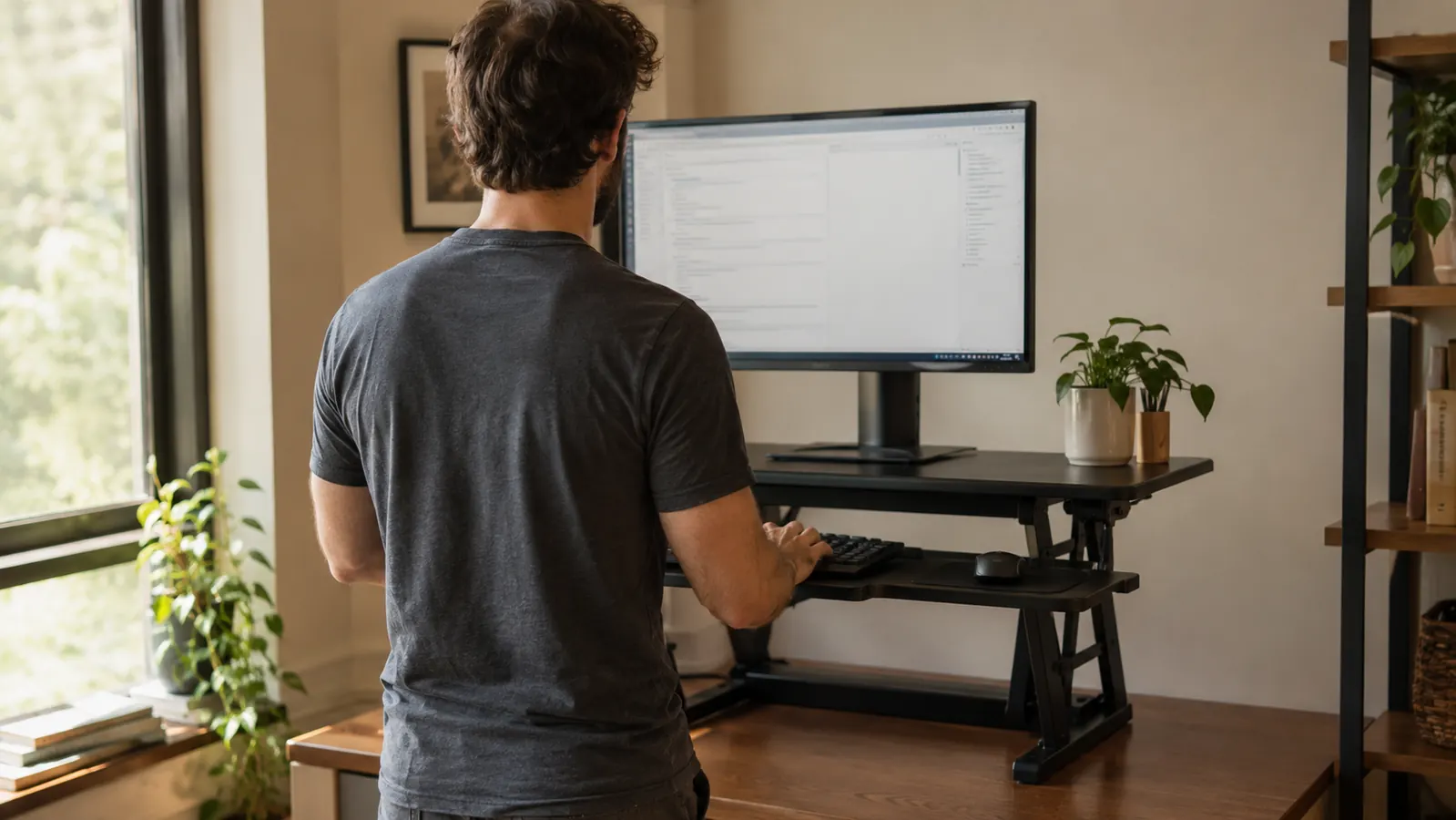
Now the honest list, because every review needs one. The keyboard tier is shallower than I would like. My forearm rests near the edge when I use the mouse, and after a long hour it reminds me. A compact mouse pad solved it for me, but if you have long arms or a large mouse, measure the tier depth before you buy.
The lock release works every time, but it is not graceful. It takes one hand underneath to reach the lever while the other hand supports the platform. Six months in I can do it without looking, but late in the day it sometimes takes two tries. Not a dealbreaker, just a small fumble.
The third annoyance is cables. The monitor goes up and down while its cables stay behind the desk, so those cables need slack. I spent part of an afternoon bundling the monitor cord and the video cable into a spiral wrap that can move with the platform. The VIVO itself needs no power, which is good, because my power strip already has its hands full. Give yourself one cable afternoon when it first arrives and the issue disappears.
The last tradeoff is desk space. The converter occupies the center of my desk, and the surface I used to spread out over is smaller. I keep current project notes next to the keyboard now, and they fit, but just barely. If you work with big paper layouts or two giant monitors, this is the wrong category entirely.
Full Standing Desk or a Converter Like This One
You may be wondering whether a full standing desk would have been the better purchase. I used one for two weeks at a client site and it was a good desk. A full desk gives a wider height range, which matters if you are very tall or very short, and it offers more room to spread out while standing. It also replaces the furniture you already have, needs floor space, and takes an afternoon to assemble. For my room, that trade was not worth it.
I like my desk, I like my office, and I do not like sitting for six hours. The VIVO fixes the one part I do not like without disturbing the other two. A full standing desk would solve the same problem but create three new ones: what to do with the old desk, where to put a new one, and what happens when the new one does not fit the room. If you are starting with an empty office, buy the full desk. If you are starting with the office you already have, the converter is the more practical answer.
One more note about range. At its lowest setting, the converter raises the keyboard a few inches above the bare desktop. That is not a problem with an adjustable chair, but it can surprise you if your chair is already at its maximum height. The fix is simple: raise the seat a couple of clicks. It is the kind of detail that only shows up after you have lived with the product for a while.
What I Liked
- Adds comfortable standing height on the desk you already own, with no power cord and no motor
- Monitor sits at eye level in both sitting and standing positions
- Keyboard and mouse stay together, so your hands are not wandering between a separate riser and a tray
- Stable base holds firm while typing
- The whole thing disappears into your routine after two weeks
Where It Falls Short
- Lift is stiff at first and needs two hands until you learn the release
- Keyboard tier is shallow and mouse room depends on your arm length
- Occupies the center of the desk, shrinking the surface for papers
- Adds height even at the lowest setting, which may require raising your chair
Who This Is For
Buy this if you already have a desk you like, one main monitor or a monitor plus a laptop, and a body that starts complaining around two in the afternoon. Buy it if your office is too small or too settled for a second piece of furniture, or if you want to test whether standing helps before you commit to a full standing desk. If you recognize yourself in any of those sentences, the VIVO will likely earn its place on your desk the way it did on mine.
Who Should Skip It
Skip it if your workday needs two large monitors or a wide desktop for paper. Skip it if you are unusually tall or unusually short, because a converter's range may not line up with your elbows. And skip it if you have the room and the budget for a full standing desk, because that really is the more complete tool. The converter is a compromise, and it only wins when the compromise is necessary.
If you are still sitting in the same position you were in ten minutes ago, this is worth a look.
Six months in, the VIVO converter earns its place on my desk every day. If a full standing desk does not fit your room or your budget, this is the middle path I ended up keeping. See what it costs today on Amazon.
Amazon Check Today's Price on Amazon →