

When I first set up my desk in the spare bedroom at the back of my 1990s ranch house, I brought a bad lighting habit with me: one overhead ceiling fixture and no light between me and the keyboard. By the third week I was squinting at my notes, tilting the monitor, and rolling my shoulders by 3 in the afternoon. I bought a small clamp-on desk lamp to test before changing anything else. It is a Lepro LED desk lamp, 5 watts, and it clamps to the back edge of my desk. Nine months later it is still the first thing I switch on every workday.
I am not an eye doctor, so none of this is medical advice. It is simply what I noticed in my own room after switching from a ceiling light to a lamp I could aim. This Lepro has been on my desk for nine months, and I can tell you what changed and what did not.
If your eyes feel tired by 3 p.m., try moving the light before changing the monitor
A lamp you can aim at the page removed the exact source of glare that was making my eyes work harder than they needed to. It is the smallest change I made to my office that I still notice every single day.
Amazon Check Today's Listing on Amazon →Moves the light to the page instead of the ceiling
Overhead fixtures are designed to wash a whole room. Mine sat behind me and slightly above, which meant the brightest part of the room was between the bulb and my face while the keyboard stayed in shadow. This lamp is small and it clamps to the back edge of my desk, and that changes everything. I can aim it down at the page. The keyboard and the notebook receive the light, and my eyes no longer have to search for contrast. It sounds like a small fix, but it was the biggest comfort change in my office.
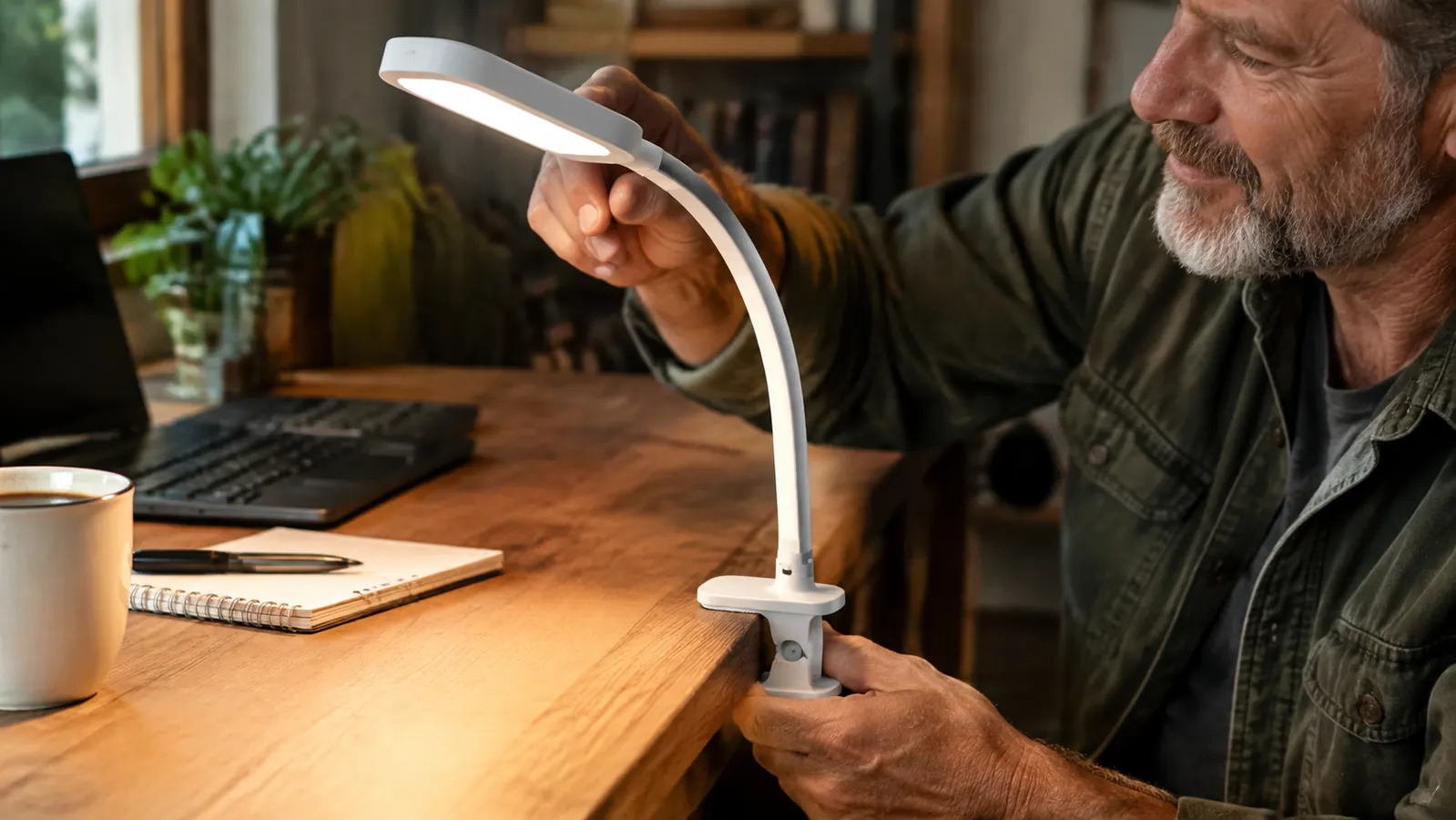
Puts a bright edge where the screen glare is not
Most people think of a screen as something that gives off light. It also reflects what is in front of it. With the ceiling light on, I used to see a soft, gray reflection across the lower third of my monitor. With the lamp on the left side of my desk, that reflection drops away because the lamp is not behind me. Text on the screen is easier to read without any additional zoom. I still keep the room light off for most of the day. The lamp does all the work I need.
Stops the shadow your hand throws across paperwork
I still print reports and mark them up with a pen. Under the ceiling fixture, my right hand sat between the bulb and the line I was reading, so every page had a moving shadow. The clamp lamp sits beside the notebook and brings light from the side. The shadow disappears. I can circle numbers, write margin notes, and compare columns without lifting the paper toward the window. People who do most of their work on screens may not care about this reason. Anyone who edits on paper will understand it right away.
Keeps the room from being too dark around a bright screen
The worst combination for my eyes was a glowing monitor in a dark room. Every time I looked up from the screen, my eyes had to adjust from bright white to near black. That adjustment is tiring. I leave the desk lamp on even when I am reading or thinking, not writing. It raises the light around the monitor so my eyes are not jumping between extremes. The lamp does not need to light the whole carpet. It only needs to soften the difference between the screen and the rest of the room.
Gives me a steady lamp instead of the ceiling flicker
I never measured the room lighting, so I will not tell you the old ceiling fixture flickered with a specific number. I will tell you this: I used to get a dull, tired feeling behind my eyes by late afternoon, and it stopped when I switched to this lamp. Part of that may be because the light is steadier, and part may be because I finally had a light source I could control. All I can report is the difference in my own routine over nine months.

Stays at the same height and angle all day
My desk sits in the same spot every day, and my eyes get used to a particular brightness. A floor lamp shifts whenever a cord gets bumped. A window changes with every passing cloud. The clamp locks this lamp at the back edge, which means the angle is the same at 9 in the morning and at 6 at night. I do not need to re-aim it unless I switch from keyboard work to paper. That consistency removes one more variable from a long work session.
Helps me read fine print without leaning toward the screen
Most of my technical writing work means reading small type in manuals. Before the lamp arrived, I caught myself leaning closer to the screen to make text sharper. That lean was the beginning of a sore neck and a tired back. With a light close to the page, small print becomes easier to read from a normal sitting position. I sit back, my shoulders stay relaxed, and my eyes can focus on the details without my whole body having to move forward.
Fills the gap left by a single north-facing window
My office has one north-facing window on the left side of the desk. It gives soft daylight rather than direct sun, and by late afternoon in winter it is not enough. The lamp fills that gap for the last hours of my workday. On bright summer mornings I can leave it off or angle it away from the screen. The flexibility is useful, because it means my eyes are not dependent on whatever the sky is doing.
Clamps to the desk and stays off the work surface
The room I work in is about 10 by 11 feet, so I do not have space for an extra floor lamp beside the desk. Clamping the lamp to the back edge of the desk keeps it off the floor and out of my walking path. It also leaves the entire work surface free for a keyboard, a mouse, notes, and a mug. If you share a desk with paperwork and other gear, the clamp design is the difference between a lamp that helps and a lamp that gets in the way.
Makes the easiest eye break habit easier
Eye fatigue is rarely solved by one tool. It is solved by a set of small habits: taking breaks, changing position, and giving your eyes a comfortable target. This lamp makes the last habit easy. When I notice my eyes are tired, I switch it on, angle it at what I am reading, and look across the room for 20 seconds. The lamp is the reason the room feels set up for my eyes instead of set up for a fixture.
What I'd Skip
If you want one lamp to brighten a whole room, skip this. It is a task light, not a ceiling replacement. The beam covers a desk, not a sofa or a dark corner. You should also skip it if your desk has no lip that a clamp can grab. I used the lamp on a desk with a plain back edge and enough thickness for the clamp to grip. On a glass top or on a wall-mounted shelf with no overhang, the clamp has nothing to hold. My final honest note is that a lamp cannot fix presbyopia, dry eyes, or a prescription that needs updating. It only fixes poor light placement. If the rest of your setup is the problem, a new lamp will not make it go away.
A light you can aim where you are looking is worth more than a brighter light that stays where the ceiling put it.
Try a lamp you can aim before you change your chair
Try the same test I did: put a lamp you can aim between your keyboard and the ceiling fixture. The Lepro version has stayed on my desk because it works, not because it is fancy. It takes two minutes to set up and about one workday to feel the difference.
Amazon Check Today's Listing on Amazon →