
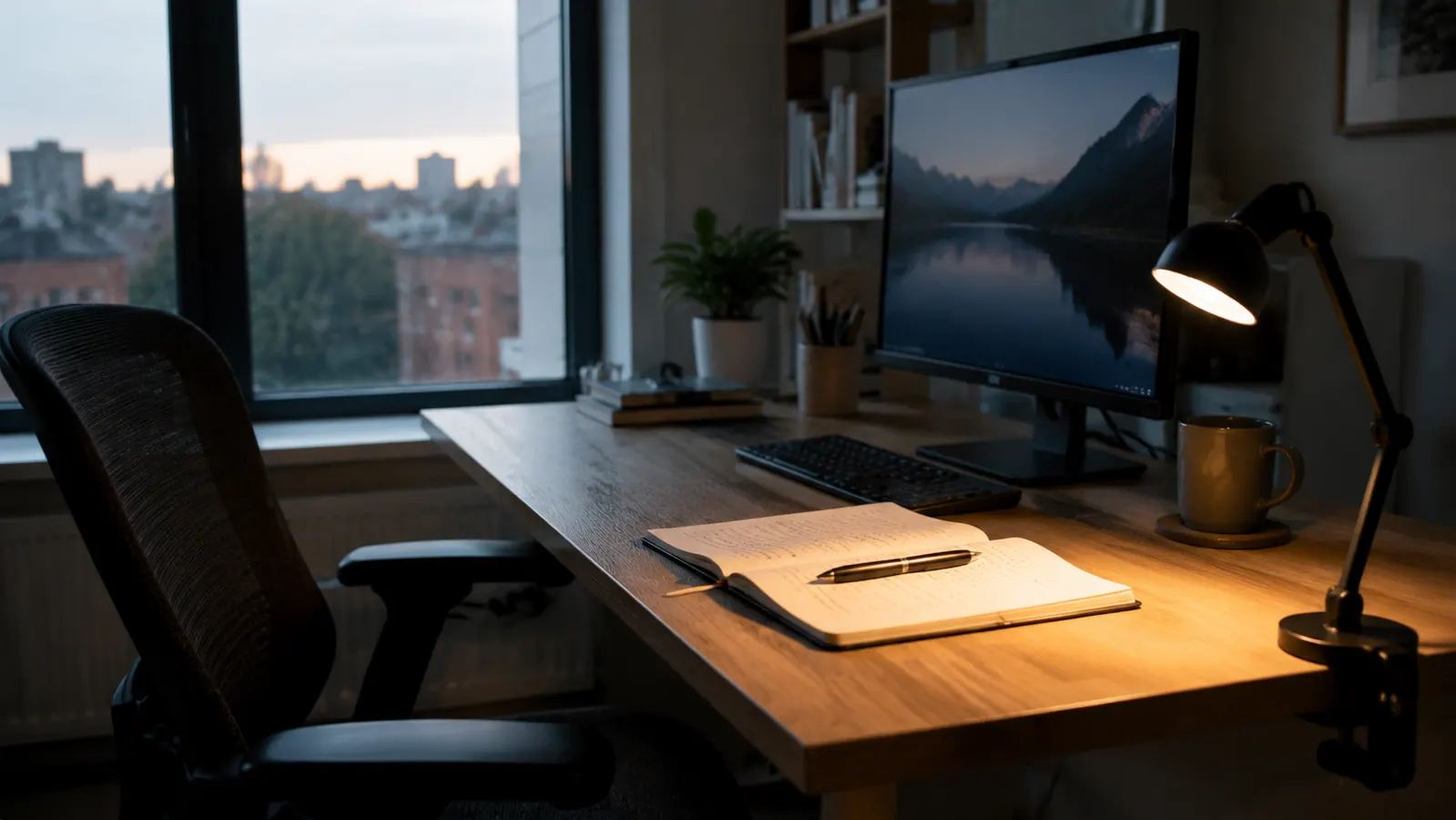
I worked for five years under one overhead light before I bought a desk lamp, and I am a little embarrassed about that. I earn my living at a keyboard, so good task lighting should have been one of the first things I sorted out. My office is a ten by eleven foot spare bedroom in a 1990s ranch house in Raleigh, with one north-facing window on the left, beige carpet I cannot replace, and a single ceiling fixture in the center. I have worked from that room since 2019, writing manuals for industrial clients, and for most of that time the ceiling fixture was my only light. The result was a lot of leaning forward, a lot of monitor tilting, and a shadow that followed my hand across the page.
Short answer: for work that happens within arm's reach, a desk lamp is better than an overhead light. I reached that conclusion after I clamped a Lepro desk lamp to the front edge of my desk last November. The Lepro is the small LED model with a clamp base, a movable arm, and 460 lumens from a 5-watt bulb. It did not replace the ceiling fixture, but it changed which light I aim at my work. This compares the Lepro with the overhead light I still switch on every day, using the notes I took from November through March.
| Lepro desk lamp | Overhead ceiling light | |
|---|---|---|
| Task light quality | Aimable 460-lumen pool that lands exactly where you read or type and does not disappear behind your own head | Even light wall to wall, but your shoulders and monitor stand can put the page in shadow |
| Monitor glare | Head moves beside or above the screen, so you can kill glare without tilting the monitor | Fixed in the center of the ceiling, so the reflection depends on where you put the screen |
| Whole-room coverage | Covers roughly two feet of desk and leaves the rest of the room dim | Fills every corner of a ten by eleven foot room and lights the path when you stand up |
| Setup and footprint | Clamp grips the front edge, but it needs an outlet and a clear route for the cord | Already wired into the room, no clamp, no cord on the desk, and no desktop space used |
| Adjustment from your chair | One hand swings the arm and pivots the head in about two seconds | You move your body or your paperwork to find the light |
Where the Lepro Wins
The difference I notice every single day is aim. My ceiling light sits in the center of the room, while my desk is against the long wall, so the light crosses six feet of carpet, passes my shoulder, and reaches the keyboard at an angle. Every time I leaned forward to read a line, my own head put the page in shadow. The Lepro sits about eighteen inches from my hands, clamped to the edge of the desk, and its head can pivot to point at the keyboard, at a notebook on my right, or at a printed page lying flat. The adjustment takes about two seconds. Because it is that fast, I make it five or six times a day instead of living with whatever angle the light happened to be in.
Consistency surprised me more than raw brightness. The ceiling light in my room never looks the same for two hours in a row because daylight from the window mixes with it and shifts as clouds pass. On a gray January morning, the ceiling light alone makes the paper look flat and muddy. The Lepro produces a steady pool of 460 lumens, so the document I edit at 8:00 in the morning still has the same contrast at 3:00 in the afternoon. For someone who spends six hours reading and revising the same manual, that steady light is worth more than any extra candlepower.
It also runs cool and silent, which I did not expect from a lamp. A halogen desk lamp I owned years ago made the back of my hand feel warm after an hour and made my small office noticeably hotter by evening. The Lepro is an LED, so it puts its energy into light, not heat. It has no fan and no hum, and I keep it close enough that a microphone on my desk never picks it up during video calls. My overhead fixture is quiet too, but it cannot be moved closer to me, and it cannot avoid reflecting off the screen when I tilt the monitor.
The clamp is the feature that really sold me. My desk is only four feet wide, and I use a full-size keyboard, a monitor on a stand, a notebook, and a mug of coffee, so there is no spare real estate for a lamp base. The Lepro clamps to the front edge of the desk, which leaves the whole desktop clear. My previous desk lamp had a heavy round base that took up a six-inch circle, and its neck would not move unless I loosened a threaded knob behind the shade. That meant standing up and leaning around the monitor to change the light. The Lepro arm moves in one clean motion, and I can do it without breaking eye contact with the screen.
Before the Lepro, I tried two other fixes that did not work. A floor lamp behind my chair made the whole room brighter but still left the monitor with a reflection. An under-shelf light stuck to the bottom of a bookcase flickered and threw a shadow from my arm. I almost gave up and bought a new monitor with a matte screen. What I needed was not a better screen or more light in the room. I needed a small source that I could move within inches of the paper. That is a long way of saying I understand if you have tried lamps before and they did not help.

Where the Overhead Wins
Now I have to be fair to the ceiling light. It does one thing the Lepro cannot do, and that is fill the room. The lamp's pool of light covers maybe two feet of my desk and a little spill beyond it. When I push my chair back to think, or walk across the room to the closet I turned into shelving, I step out of that pool and into near darkness. In the evenings, that is not a pleasant way to move around. The ceiling fixture spreads light across the full ten by eleven feet the moment I flip the wall switch, and it makes the whole room usable, not just the two feet in front of my keyboard.
It also costs nothing to set up, since it was already part of the house. The Lepro needs an outlet, a clear path for its cord, and a desk edge thick enough for the clamp. My desk has a flat edge about three quarters of an inch thick, so the lamp fits securely, and I mounted a power strip underneath to hide the cord. If my desk had a rounded lip or a very thick butcher-block top, I would have needed a different mounting plan. The ceiling light will never ask me to measure anything. It is simply on the wall switch, ready when I walk into the room.
The overhead is also the light I use when I want the room to look like a normal office instead of a desk in a cave. The lamp creates a strong, directed pool, which is useful for work but harsh on the rest of the room. If someone walks in while I am on a video call, the ceiling light makes the background look less dramatic. I cannot count the number of times I turned off the lamp for a call and turned the ceiling light back on so the camera would show a more even room. The ceiling light is also the switch I reach for when I am done for the day. I do not want to bend under the desk to turn off the Lepro after I have already shut down my computer. Hitting the wall switch on my way out takes one second, and that is part of why the overhead stays.
One odd benefit of the overhead is posture. When I rely only on the lamp, I catch myself leaning toward the pool of light. When the whole room is lit evenly, I sit back in my chair and keep my shoulders over my hips. I have a lower-back complaint from an old car accident, so posture is not an abstract idea to me. It was another push toward keeping both lights in the room.
The Lepro Is the Desk Half of the Pair
After a winter of writing under both, I can tell you the ceiling light is worth keeping and the Lepro is worth adding. The lamp is the one I aim at my notes, my keyboard, and the printed pages I edit. It clamps out of the way, runs cool, and its arm moves in seconds. If you are tired of leaning toward your only light, this is the model I would start with. Check today's price on Amazon.
Amazon Check Today's Price on Amazon →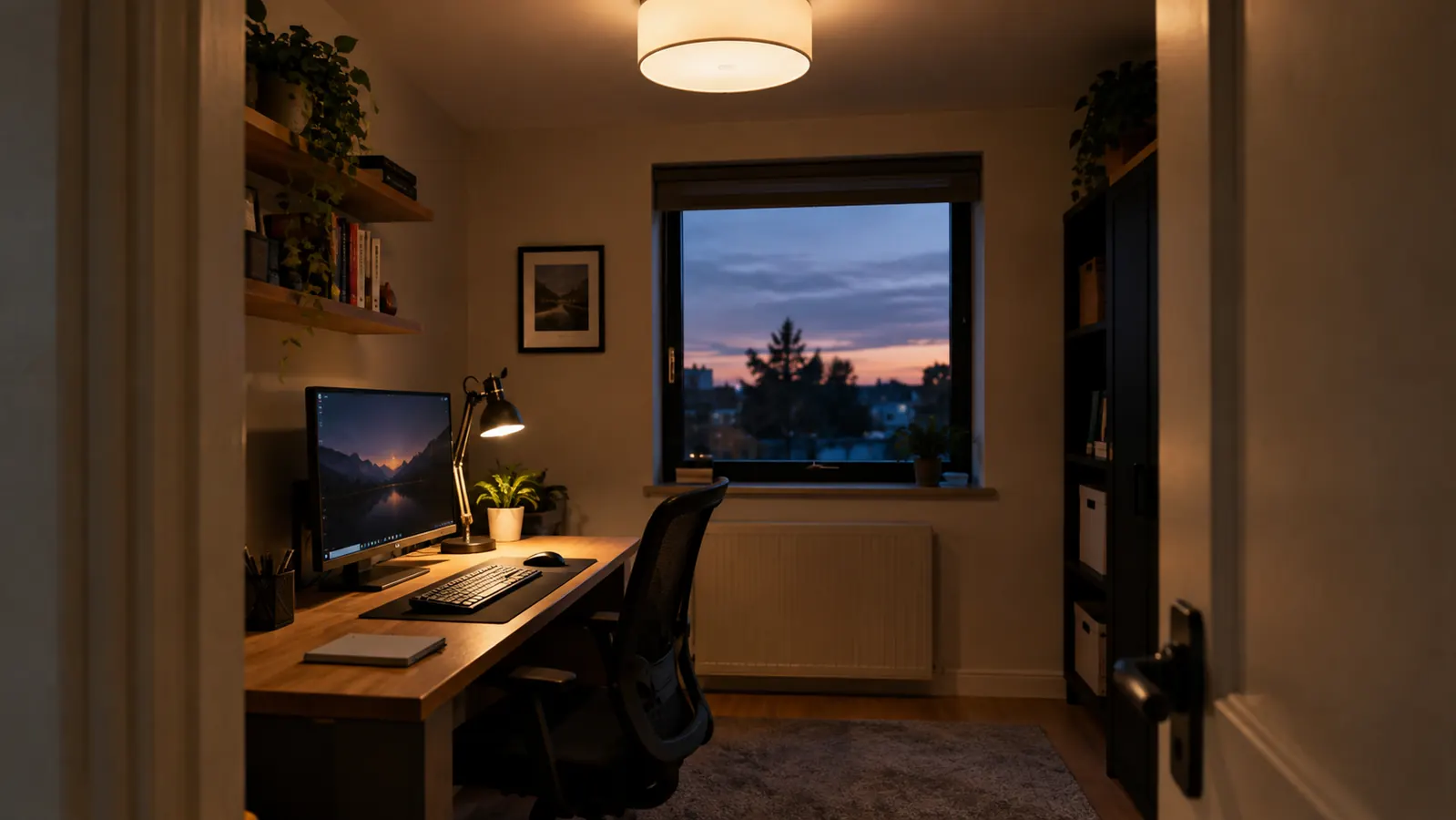
Who Should Buy Which
If you work at a fixed desk for more than an hour or two a day, and your only light is a ceiling fixture, buy the lamp. That is the use case I know from my own room. You do not have to remove the overhead or fight with a renovation. Keep the ceiling light for whole-room brightness and add the Lepro for the page under your hands. It clamps on in thirty seconds, and the desktop stays clear, which matters if your desk is as small as mine.
If your desk time is mostly short email checks, or you already have bright overhead light that does not cast a shadow at your hands, the lamp is an unnecessary purchase. My ceiling light was fine for reading one-page notes and answering messages. It only failed me on long writing sessions, where the shadow and the glare built up over hours. If you have never noticed that buildup, save your money and keep using what you have.
Measure your desk before you order. My front edge is flat and about three quarters of an inch thick, and the Lepro clamp holds it well. I tried the same lamp on a friend's butcher-block kitchen table, and the clamp would not open wide enough to feel secure. That is not a design flaw; it is a fit issue. If your desk has a thick edge, metal trim, or a routing channel, look for a clamp with a wider opening or choose a lamp with a weighted base instead.
Who is the lamp really for? It is for the person who writes, edits, or reads at one desk for hours and has slowly gotten used to craning toward the light. I did that for five years and told myself the ceiling fixture was fine. The Lepro did not fix my posture overnight, and it did not make the ceiling light obsolete. It simply gave me a tool I can aim wherever my eyes are working at any given minute. For me that is the definition of the right desk lamp.
One last thought: I still turn on the ceiling light first when I walk into my office. The Lepro is not a replacement; it is the second switch I flip after I am sitting down. That order matters. The room light gets me in the door, and the desk lamp gets me to work. If you only take one thing from this comparison, take that sequence.
Start With the Lamp, Keep the Ceiling Light
The honest conclusion from my office is that the lights are partners, not rivals. The Lepro handles the two feet of desk where the writing happens, and the overhead handles the rest of the room. If your setup still depends on one distant ceiling bulb, try the Lepro and see how much easier it is to read a page at 4:00 PM. Check today's price on Amazon.
Amazon Check Today's Price on Amazon →