
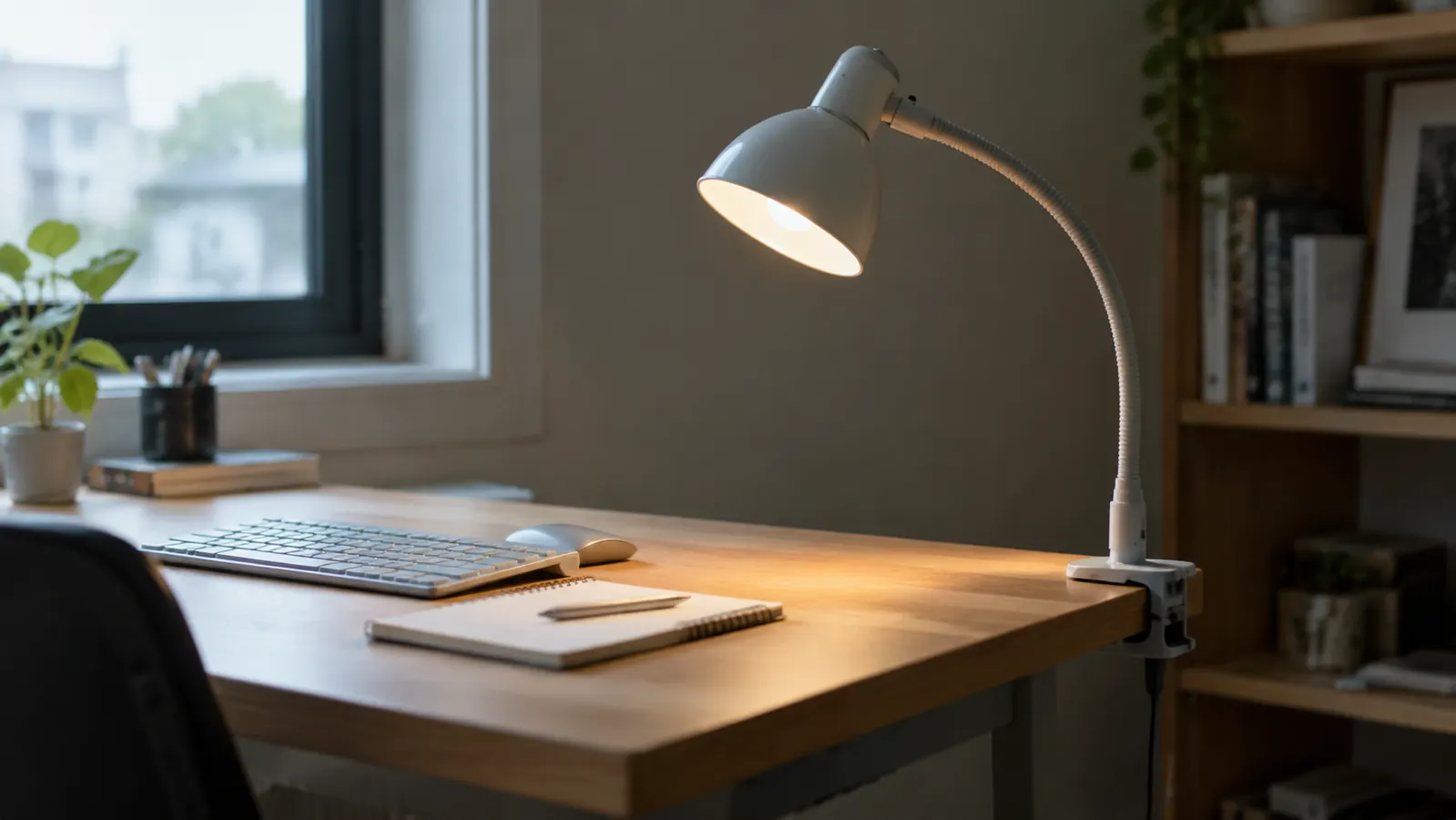
I have one window in my office, and it faces north. For the first four years I worked from this room, I used an overhead light that threw most of its glow onto the wall behind my monitor and left the keyboard in shadow. By December, I found myself leaning toward the screen by late afternoon, and by 4:00 I could not tell if the room was dark or my eyes were tired. That is the problem the Lepro desk lamp solved. Six months later, with the lamp clamped to the back edge of my desk and the arm angled over my keyboard, I am still using it every day, and I plan to keep it here.
The Quick Verdict
A small, dependable task lamp that gets light exactly where you need it and has held up to six months of daily use. The control button is awkward, but the light quality is worth it.
Amazon Check Today's Price →Six months later, this lamp is still clamped to my desk
If you are fighting a dark corner the way I was, check today's price and reviews on Amazon to see if it fits your setup.
Amazon Check Today's Price on Amazon →How I've Used It
I work from this room five days a week, usually from 8:30 until 5:00, with a break around noon. My desk is pushed against the long wall, so the window is to my left and slightly behind me. That means for most of the day I write with my back to the natural light, and the only light hitting the keyboard comes from the monitor. I tried a floor lamp, but it sat behind me and cast exactly the wrong shadow. I tried a cheap battery-powered puck light clipped to the screen, which helped for a month and then started flickering. In early March I attached the Lepro lamp to the back edge of the desk, just left of the monitor arm, and angled the head down over the keyboard. I also moved my keyboard a few inches to the left just so the lamp arm would not cross my writing hand, a detail that matters more than you would think.
The clamp opens wide enough to fit over the desk lip, about three-quarters of an inch, and the mounting screw lets me tighten it without moving the lamp. I set the arm so the head hangs about ten inches above the keys, tilted slightly toward me. That puts a pool of light roughly the size of a large placemat across the keyboard, the notebook, and a corner of the monitor. It does not light the whole room, and I do not expect it to, but it removes the dark triangle between my hands and the screen that was bothering me most. The light is steady at every angle, and even when I shift the arm to reach a document on the right side of the desk, the pool of light moves with it without flickering.
On a typical writing day, the lamp is on from my first coffee to about 2:00 PM, when the sunlight from that north window makes the room bright enough to turn it off. In summer I use it perhaps an hour total, because daylight lasts longer. In winter that north window never gives direct sun, and I have used the lamp every single working day for seven or eight hours. Nothing has loosened, the LED has not dimmed that I can notice, and the head stays where I point it.
The lamp has also survived one accidental pull of its cord when I rolled my chair over it. It came unplugged from the USB hub, and the clamp held the lamp in place while I plugged it back in. That is the only time it has failed me.
The Clamp and the Arm
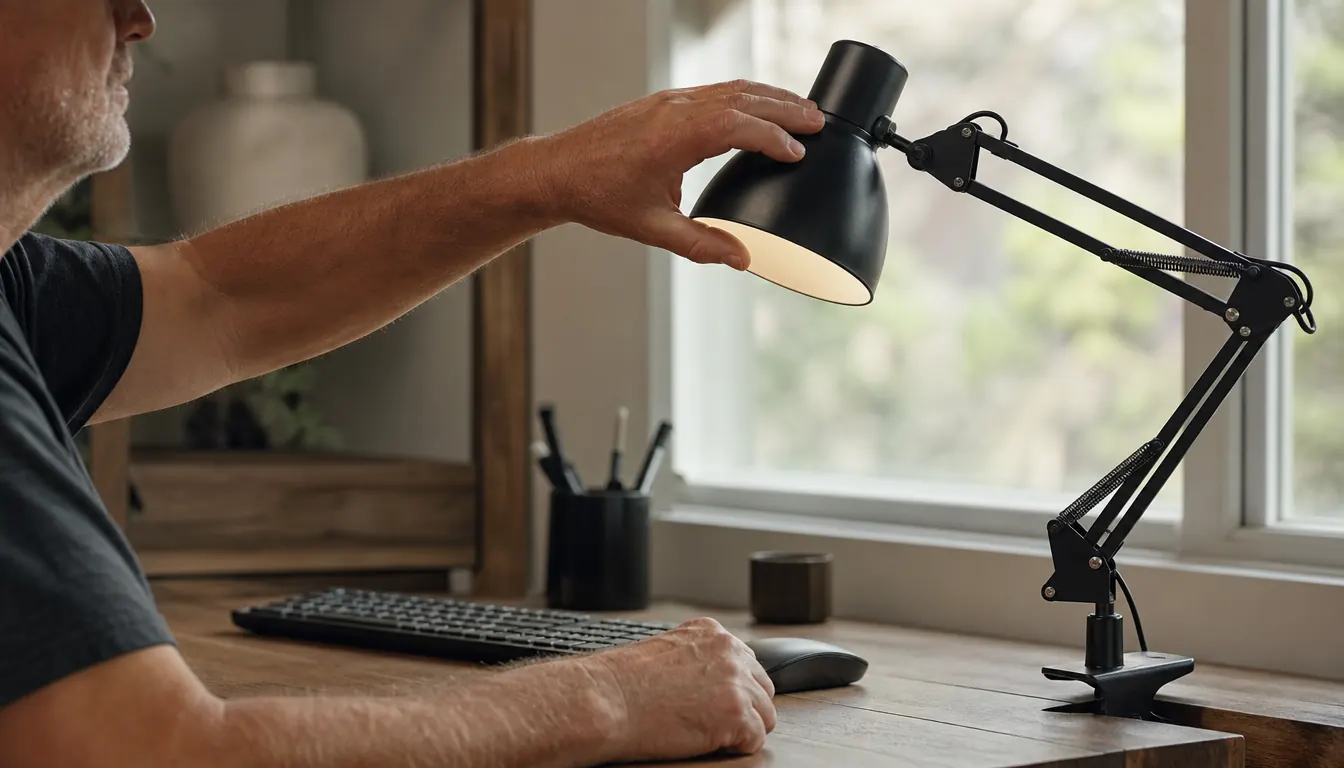
The part of this lamp that surprised me is the clamp. I expected a flimsy spring clip, but it is a proper threaded clamp with a steel screw and rubber pads. It has not scratched the desk, and it has enough reach that I can attach it to a shelf or a headboard if I ever move it. I have it clamped to a strip of oak that is about five-eighths of an inch thick, and it holds firm. The rubber pads keep it from scuffing the painted edge of my desk, which is a concern I had with metal clips. One day I bumped the arm while reaching for a notebook, and the whole lamp moved about two degrees, not enough to bother me.
The arm is a segmented metal limb with friction joints. The head sits on a ball joint, so I can point it down at a paper or sideways toward a second surface. What I cannot do is extend the arm very far across the desk. The reach from the clamp to the head is roughly a foot, maybe fourteen inches if I straighten every joint. That is fine for a desk lamp, but it means the clamp has to sit close to where the light lands. If the lamp is clamped at the far edge of a deep desk, the light will not reach the middle. My desk is thirty inches deep, and I had to place the clamp about seven inches from the edge to get the angle right.
Light Quality and My Long Writing Days
The light that comes out of this lamp is neutral white, with a slight cool cast. It has three color temperature settings, and I keep it on the middle one, which looks closest to daylight. The brightest setting is enough to read a printed manual three feet away, and the dimmest is good for writing in the evening without waking up the whole room. I have found that I do not need to think about the lamp after I set it. It does not create glare on my monitor because the head is diffused and I aim it slightly away from the screen. There is a slight shadow at the edges of the beam, but that is natural for any directional lamp.
Eye strain is the reason I bought a task lamp in the first place. I had been blaming my tired eyes on the monitor itself, but six months ago I spent a day in a client's office under a skylight, and realized the difference was the light on my workspace. Now on days when I work from this room with the Lepro lamp on, I reach for reading glasses less often. I cannot prove a direct connection, but the afternoon headaches I used to get are much rarer. I will say that this is not a full-room light, and if you need to light up a whole office, this is not the tool. I mention this because the desk lamp world is full of lights that pretend to be monitors or speakers, and this one simply does its job without gimmicks.
The color temperature is steady. I have owned LEDs that start to flicker or change tint after a few months, and this one has not. The manufacturer rates it for a long lifespan, which I cannot verify, but after about a thousand hours of use I have not seen a dip in brightness.
I have also tested the lamp at different points in the day. At 8:30 in the morning, the neutral setting helps me start writing without turning on the overhead light. In the late afternoon, I switch to a warmer setting for the final hour, which feels less harsh. The fact that I can change the tint is useful, because my energy and focus change as the afternoon goes on.
What I Wish Were Different
In six months, the one thing that still annoys me is the button. It is a small rubber switch on the side of the lamp head, and it is just barely reachable when the arm is in my normal working position. To change brightness or turn the lamp off, I have to reach around the head. I have, on more than one occasion, turned the lamp on when I meant to turn it off because the button is not labeled and the press is ambiguous. This is a small design flaw, and once the lamp is on, I do not think about it.
Another limitation is the cord. It is a little over five feet long, with a USB power plug. My desk outlet is on the wall to the right, and the cord reaches, but just barely. If your desk is in the middle of a room, you will need an extension cord or a USB hub. There is no in-line switch on the cord, so you use the button on the head. The head also runs slightly warm after a long day, not hot, just warm to the touch.
One more detail: the head tilts up and down and rotates through almost a full circle, but it does not click into fixed positions. You push it where you want it and it stays. If I bump the desk hard, it can shift a few degrees, but it has never slipped by itself.
Small Surprises: Video Calls and Reading
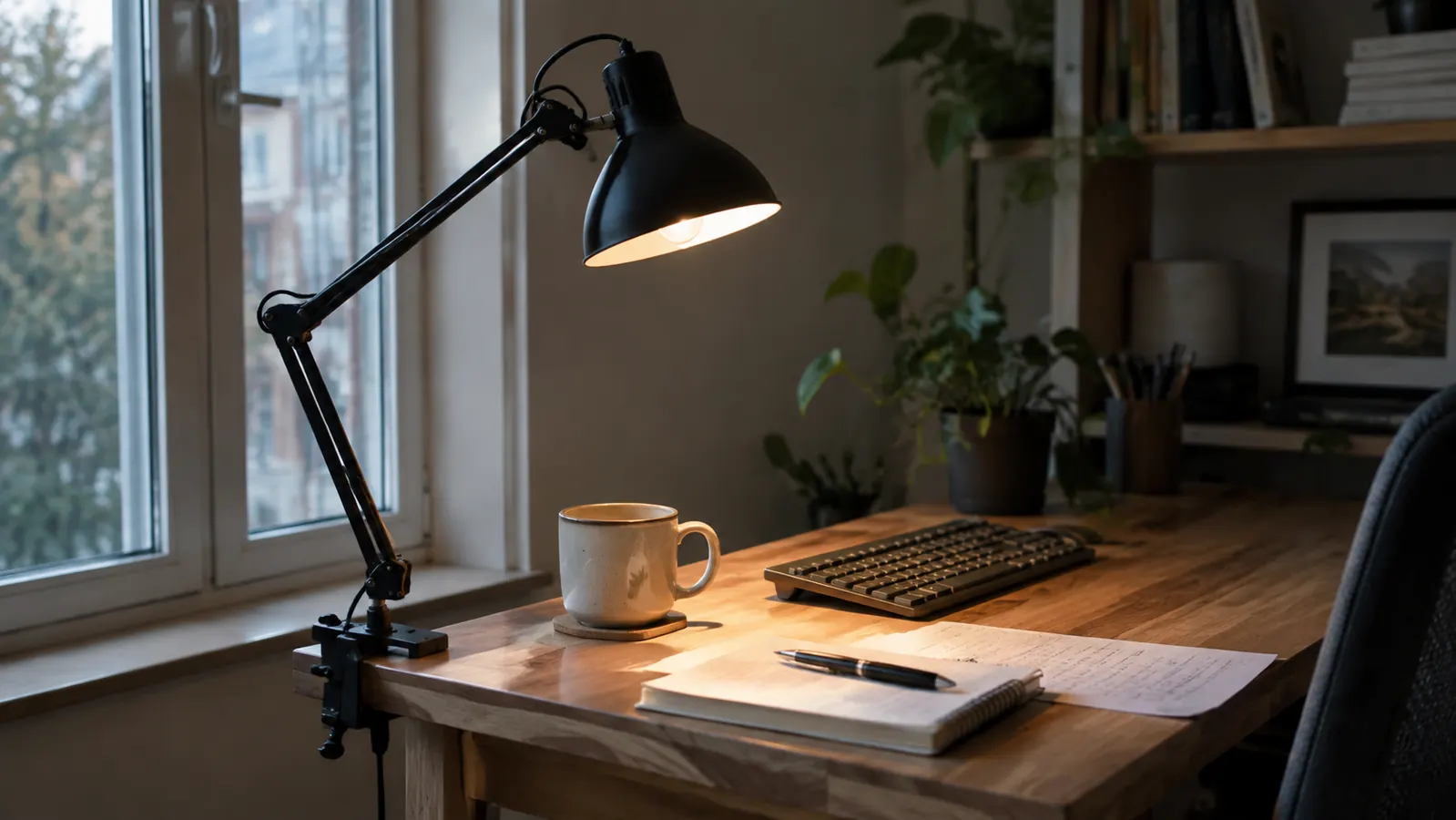
I did not buy this lamp for video calls, but it has turned out to be useful for them. My only light during calls is usually the monitor, which leaves my face half in shadow. When I have a screen share and I want to look awake, I tilt the lamp head up so it lights my face instead of the keyboard, then lower it back down after the call. The downside is that this washes out the screen, but it is better than looking like a ghost.
I also use it for reading. I have an armchair in the corner of this office, and I carried the lamp over to read on a cloudy Sunday. The clamp attaches to the arm of the chair, although the arm is a bit short for a thick recliner cushion. It worked well enough. I would not call it a floor lamp replacement, but for a specific reading spot it is handy.
The plastic feels solid, not brittle. The joints do not slip, and the head has a slight default tilt that wants to point downward. After a month I stopped adjusting it because it stayed where I put it. That is more than I can say for the previous lamp I used, which sagged over time.
What I Liked
- Puts light exactly where you are working
- Clamp holds firmly and does not scratch the desk
- Three brightness and color settings
- Compact, leaves the whole desk surface free
- Solid build, no flicker or sagging after six months
Where It Falls Short
- Button on the head is awkward to reach
- Cord is on the short side
- Arm reach is limited to about a foot
- Not a whole-room light
- Head runs slightly warm after long hours
When January afternoons go dark at 4:30, this lamp has been on my desk every single day, and it has not flickered once.
Who This Is For
This lamp is for anyone who works in a room with one window or no window and needs a steady pool of light on their work surface. If you spend long blocks writing, editing, or doing close work like soldering or sewing, the ability to aim the head exactly where you need it is worth the clamp layout. It is also a good choice if your desk is against a wall and you have no space for a floor lamp. The clamp keeps it out of the way. For me, the clamp is the reason I did not go back to a traditional weighted base lamp, which always ended up pushed to one side of my notes.
If you are the kind of person who switches between a laptop, a notebook, and a recording setup through the day, the adjustable arm makes it easy to point light at whatever is in front of you. I am not handy, and I installed it in under two minutes with no tools. The USB power means I can run it from a laptop port or a wall adapter.
Who Should Skip It
If you need to light a whole room or a large conference table, this is not the lamp for you. The beam covers an area about the size of an open newspaper, and the rest of the room stays in whatever dimness it was in. If you regularly work from two different desks, you will probably want a lamp for each, because the clamp is sturdy enough that you will not want to detach it every day.
Also, if you hate reaching around a lamp head to find a tiny button, you may find the control design frustrating. The button has three brightness levels that cycle in one direction, so switching from bright to dim requires tapping through all three. It is not a dealbreaker for me, but it is worth knowing before you buy.
The Lepro lamp is still working for me
If your desk has a dark corner like mine did, it may be worth a look. See the current price and customer reviews.
Amazon Check Today's Price on Amazon →