
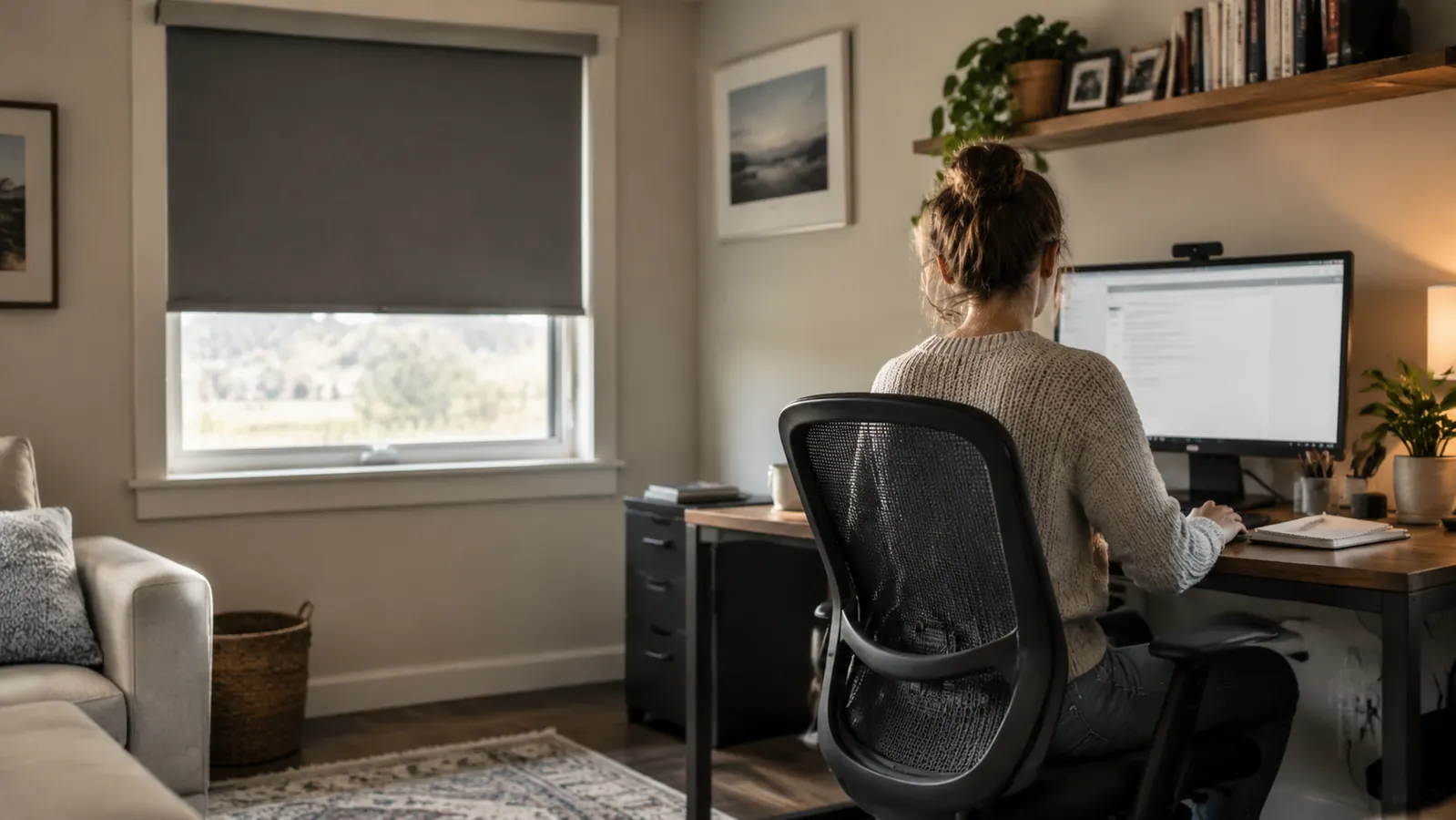
When I tell people my home office has one window, they usually imagine a dark room. Mine is not dark, exactly, but the light is uneven, and uneven light is its own kind of problem. I work in a converted spare bedroom at the back of a 1990s ranch house in Raleigh. The room is 10 by 11 foot, with beige carpet I cannot replace and a single north-facing window on the left wall. North light is steady and cool, which sounds pleasant. It means the window never blasts the room with sun at noon, but it also means the room sits in a soft gray wash for most of the day. For five years I ignored all of that, and I regretted it.
Then a Lepro desk lamp with a clamp found a permanent spot on the front edge of my desk, and the room finally made sense. I had owned other lamps before it: a floor lamp that ate a corner, a desk lamp with such a heavy base that it pushed my keyboard out of reach. Both ended up in a donation pile. The Lepro attaches to the desk edge, so it adds light without eating work surface, and because the head is small, I can point it exactly where my eyes are working. That sounds like a small thing. It was the difference between a room I endured and a room I actually wanted to work in.
The lamp that fixed my one-window office
I have used this Lepro clamp lamp every workday since it arrived. It clamps to the front edge of my desk, points where I need it, and does not take up one inch of usable surface. It holds a 4.6 star average across more than 10,000 Amazon ratings. Check today's price and see whether your desk needs the same fix.
Amazon Check Today's Price on Amazon →Step 1: Give the Window a Job Beside You, Not Across From You
The most important decision in a one-window office is not the lamp. It is where you put the desk. If the window ends up behind the monitor, you sit between the glass and the screen, which gives you the worst of both: the screen picks up the daylight in a long smeared reflection, and anyone on a video call sees you as a dark shape with a bright rectangle behind you. Put the window off to one side and it becomes a soft side light, the kind of light photographers try to recreate with expensive equipment. The light wraps across your face and your work, and the shadows fall where a lamp can fill them. My spare room only allows one practical layout, but that layout happens to put the window on my left at arm's length, which is the side-light position I would have asked for anyway.
If you are arranging a desk from scratch, spend half an hour moving it around before you spend any money on lighting. Face the wall, not the window. The goal is to have the window off to one side and the monitor where your eyes rest without strain. Once the desk is set and the chair is comfortable, the lighting question becomes much easier. A bright room is no use if the page in front of you is in shadow.

Step 2: Tame the Window Before You Add Artificial Light
Do not treat a window as all or nothing. A north-facing window never gets direct sun, which sounds ideal, but it still changes through the day: bright and cool in the morning, gray and flat by late afternoon, and actively dim in winter. The beige carpet does not help because it bounces that gray light around and makes the whole room feel dingy. I keep a simple roller shade on my window and use the middle position more than I expected. It cuts the bright stripe across my monitor while still letting useful light into the room. If you have blinds instead, angle the slats up, which sends daylight to the ceiling, where it bounces down softly instead of striking your eyes directly.
I spent a week watching the reflections on my monitor before I adjusted anything. The main culprit was the window itself, mirrored in the screen. The fix was small and free: I turned the monitor a few degrees so the window sat beyond its left edge instead of reflecting down the face, and in the afternoon I dropped the shade partway. Do this before you buy a lamp. A task light cannot fix a screen you cannot see. When I tell people this, they expect the room to feel darker with the shade down. The opposite happened: once the monitor stopped fighting the daylight, the screen was easier to read and the room felt calmer.
Step 3: Aim a Clamp Lamp at the Shadow on Your Work
This is the step where a lamp earns its place. With the window on my left, the right half of my desk sat in shadow for most of the day. That was the side where the wired keyboard lived, along with the printed pages I mark up in red pen before I type. My work is technical documentation, so I switch between paper and screen all day, and my eyes had to adapt every time. Worse, I tended to lean into the dark patch to read, a small repeated motion that is exactly what makes my lower back complain by five o'clock.
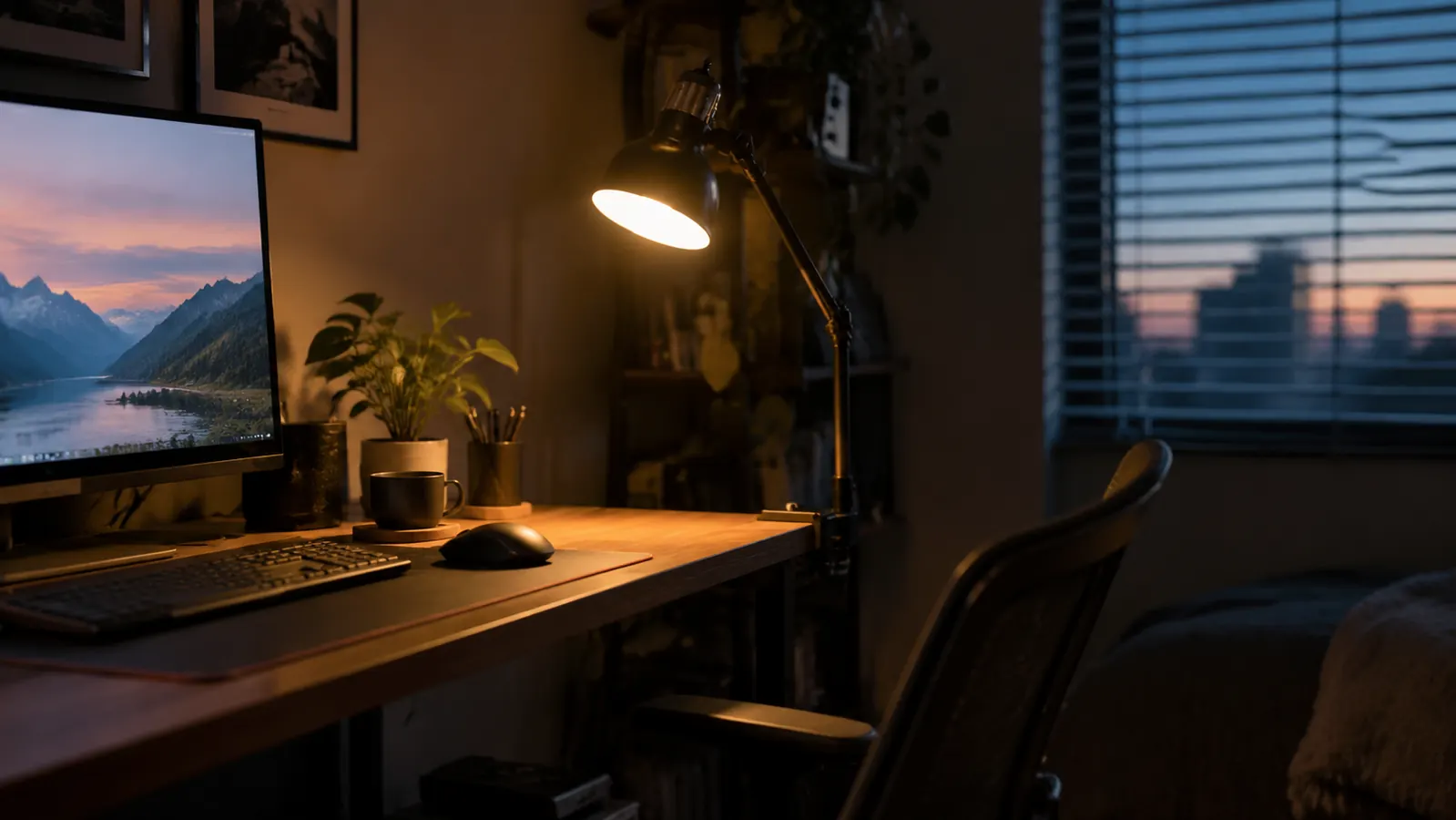
The Lepro lamp changed that because it clamps to the front edge of the desk on the side where the shadow was. No base on the work surface, no cord stretched across my keyboard. The clamp holds the lamp out of the way, and I angle the small head so light lands on the notes instead of in my eyes. The lamp is rated at 460 lumens from a 5 watt LED, and that modesty is a feature: it creates a clean pool of light on the page without washing out the monitor next to it. A task light that competes with your screen is not a task light, it is a glare machine.
If you are trying this at home, put your lamp on the side opposite the window and point it at the surface where you actually work. In my room, the window is on the left, so the lamp belongs on the right. You will notice the difference the first time you read a printed page without tipping your head toward the light. For me, with a lower back that has been sensitive since a car accident in 2015, that small change has been worth more than any chair adjustment.
Step 4: Keep a Video Call Setting Ready
Three or four afternoons a week I have video calls with clients, and for a long time they went badly in a way I could not name. The window lit one half of my face, the monitor did nothing for the other half, and I looked like a person sitting at the mouth of a cave, half in light and half in shadow. I assumed the answer was a ring light, which I did not want because my desk is crowded. Instead, for calls, I move the Lepro lamp to the right side of the monitor and point it at my face. It fills the shadow the window leaves behind.
The result is not a studio look, and it does not need to be. It is simply a normal-looking face on a work call. I angle the head so the light falls on my face and not on the screen, which on camera reads as a gentle fill rather than a floodlight. When the call ends, I slide the lamp back to the writing position. Because it clamps to the desk, the whole move takes a few seconds. A desk lamp is not a substitute for a proper video light, but in a room with one window, it closes most of the gap. If you have a window on the opposite side, put the lamp on the far side of the camera; the fill belongs on the side the daylight is not.
Step 5: Set Up an Evening Light Before You Need It
The overhead fixture in this room is a shallow dome with a bare bulb, and it is the one light source I actively avoid. It makes the monitor look washed out, casts hard shadows under the desk, and at night it feels like an interrogation. Most days I write until the window starts to fade, which in winter happens by four in the afternoon. The old version of me flipped on the overhead and spent the rest of the evening with tired eyes. The current version reaches for the lamp first.
The desk lamp lights the work surface, and the monitor adds a second glow from the front. The rest of the room can go dark, and I have stopped caring. You do not need a bright room. You need a bright page. Working in one pool of light feels closer to reading in a library carrel than to sitting in an office building, and it is easier on my eyes because the lamp is not glaring into my peripheral vision. I have not turned on the overhead fixture for an evening of work in months, and I do not expect to go back.
What Else Helps
A few unglamorous habits made more difference after the lamp arrived than before it. The first is cleaning the window. A north-facing window collects a film of dust and grime without anyone noticing, and that film eats a surprising amount of daylight. Every few weeks I wipe the glass, and I am always struck by how much brighter the room becomes. The second habit is refusing to light the whole room evenly. A pool of light where you work and soft shadows elsewhere is comfortable. Chasing an evenly lit room is how people end up under a fixture they hate.
Light and posture travel together. My lower back has been sensitive since a 2015 car accident, and I have learned that I do not slouch because of the chair. I slouch because I am leaning toward something I cannot see. A lamp that puts light on the page has done more for my sitting position than the ergonomic chair did, which is a sentence I did not expect to write. If your neck or back hurts at the end of a writing day, look at what your eyes are straining to see before you blame the furniture.
One more thing worth doing is testing your setup the way you will actually use it. I spent an afternoon pointing the lamp at everything, then left it in one place for a full workday. The lamp now has two positions in my head, one for writing and one for calls, and moving between them takes me seconds. That is what you are really building here: a light that follows the work instead of making the work follow the light.
Finally, stop blaming the room. For years I told myself the light problem would be solved by a renovation, or by moving to a bigger office with two windows. It was not. It was solved by managing the one window and clamping a small lamp to the front of the desk. You probably do not need to remodel either. You need to put light where your work actually happens, and that is a fix you can make this afternoon.
In five years of working in this room, no change has done more for my eyes and my lower back than putting a small lamp in the shadow to the right of my keyboard.
The lamp I would buy first for a one-window office
I have used this Lepro desk lamp every workday since it arrived, and I would choose the same one again. It clamps on, points where I need it, and it has a 4.6 star average across more than 10,000 Amazon ratings. Check today's price and decide whether your desk needs the same fix.
Amazon Check Today's Price on Amazon →