

If your home office has one overhead light, you already know what I mean about glare. The light lands on your head, not your work. It puts a shadow under your eyebrows and turns your monitor into a mirror. I live with that every afternoon in a small spare bedroom I converted into an office. I tried a lamp with a heavy round base, then a swing arm lamp with a long spring. Both fixed the dark corner and created a worse one: they took up desk space I needed for a keyboard and a stack of reference manuals. The Lepro small desk lamp with clamp was my third attempt. I bought it because the clamp meant no base at all. I kept it because it solved something I had not expected: the direction of the light matters more than the size of the fixture.
What I want to give you here is not another spec by spec review. The specs are easy to find, and most of them tell you very little about living with a lamp. This is the honest version. The brightness is fine for close work. The glare is manageable if you aim the head away from the screen. The clamp is genuinely useful on my desk, and also genuinely finicky on the wrong edge. What nobody tells you is how much that third point decides whether you will like the lamp. This review is about that decision, and it is written after months of ordinary work, not after one enthusiastic evening.
The Quick Verdict
A small task light that earns its place on a tidy desk edge, but only if that edge is flat and within reach. Buy it for close reading and writing, not as a room light.
Amazon Check Today's Price →The Clamp Lamp That Quieted My Overhead Glare
The Lepro sits off to the side, points where you actually read, and leaves the rest of the desk clear. If your overhead light is making calls and writing harder, this is the specific fix I kept. Check today's price on Amazon.
Amazon Check Today's Price on Amazon →How I've Used It
My office is a 10 by 11 foot spare bedroom at the back of a 1990s ranch house. The desk is against the long wall, with one north-facing window to my left and the overhead light directly above. I have worked in that room since 2019, doing long documentation blocks, three or four video calls a week, and the usual amount of email. The overhead fixture was never good enough. It leaves my face half in shadow and makes the monitor washed out.
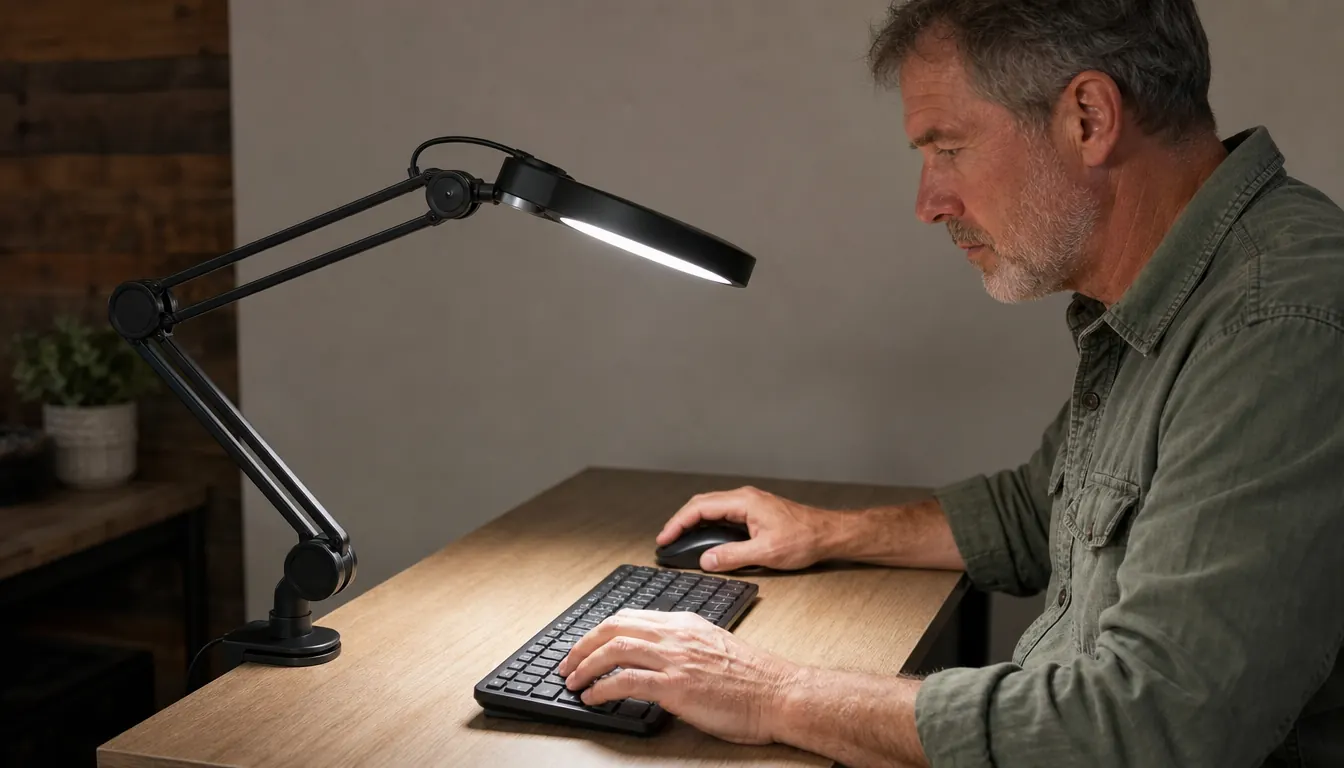
The Lepro is mounted on the front edge of the desk, about a hand's width from the left corner. I aimed the head backward and down, so the light falls on the keyboard and on the paper notes I keep near my left hand. The monitor sits mostly in shadow, which is what I want. The lamp head is small enough that it does not block the screen, and because the clamp holds it at the edge, the whole top of the desk stays clear for a laptop stand, a wired keyboard, a mug, and a notebook.
I turn it on around three most days, when the north window stops giving me enough even light, and it stays on until I close the laptop. It is not a dramatic light. It does not change the mood of the room. It simply makes the surface in front of me readable for hours. That sounds like faint praise, but for my kind of work it is the entire job, and the lamp does not call attention to itself while doing it.
What I Learned About Brightness and Glare
I almost did not buy the Lepro because 460 lumens and 5 watts sound like a book light. The useful fact is simpler: from about twelve inches away, the light is comfortable for reading a printed page and for writing in a notebook. It is not the kind of lamp that lights up a whole room. It is the kind of lamp that creates a clear pool on the surface where your eyes are working. For me, that pool is what cuts the glare.
The glare lesson took me a week. A clamp lamp sits so close to the work that the angle between light, page, and screen is easy to get wrong. The first week, I aimed the head at the screen to stop the top of the monitor from being dark. That made the screen glossy and hard to read. When I tilted the head so the center of the beam hit the desk just in front of the keyboard, the reflection disappeared. The rule I settled on is to light the paper, not the monitor.
The other surprise was shadows. Because the lamp sits near my left hand, it casts a shadow from my arm onto the right side of the desk when I write. That is not a flaw in the lamp; it is just geometry. I work around it by keeping the notebook closer to my body and the keyboard farther right. A bigger lamp with a wider beam would have the same issue, and a freestanding lamp would simply trade that problem for the problem of a base in my way.
Another small note: the aim changes if you move your chair. When I roll closer to read a document, the beam hits my shoulder instead of the page. I adjust the head maybe once a day. Once I learned to nudge it, the glare stopped being a topic in my head and became a habit.
The Clamp: What Nobody Tells You
The clamp is the reason I bought this lamp, and it is also the reason I almost sent it back on day one. My desk has a clean straight front edge, so the clamp attached without drama. That first day, though, I put it on the wrong corner. The arm pushed the cord across my mouse area and the lamp wobbled every time I typed. The lamp was not at fault; the mounting spot was.
After I moved it to the far left corner, most of that went away. What remains is a real tradeoff: a clamped lamp owns the edge where it sits. You cannot slide it out of the way the way you can a lamp with a base, and you have to reach around the clamp to clean the desk. The head stays where I aim it, which is the point, but it does not fold flat against the desk when I want a clear surface.
The other thing nobody tells you is that a permanent clamp changes how you clean and rearrange. You cannot move this lamp across the room to do a job somewhere else. You have to release the clamp, relocate it, and re-tighten it. That takes thirty seconds, but a lamp with a base would have been on the shelf by then.
There is also the cord. On the front edge, the cord hangs down in front of your legs. On a desk with a modesty panel, you can tuck it out of the way. On an open desk, you may need a cable clip or a short extension run to keep it from tangling with chair wheels. None of that is a reason to avoid the lamp, but it is the kind of detail you only notice after you live with it.
What I Wish I Had Known First
The honest advice I would give my past self is to spend ten minutes finding the correct spot before declaring the lamp a failure. It works almost anywhere, but it works well in only a few places. Because the clamp is semipermanent, you want to decide once where it will live. Measure how much of your desk edge is flat and exposed, and look at how the cord will run.
For me, the arrangement is the far left edge with the beam crossing in front of the keyboard. A right-handed person might prefer the right edge if most writing happens on the left. In general, the front edge works best because the beam can sweep across the work without bouncing off the monitor. On a side edge, the lamp is closer to your face and you get more stray light in your eyes. The front edge is also where the cable is most visible, so you are trading one annoyance for another. Know which one you can live with.
Another thing I learned: do not judge how far the beam travels from a product photo. The pool of light is smaller than it looks online. That is fine if you are lighting one page, but it is the first thing to surprise someone used to a floor lamp.
Where the Lepro Falls Short
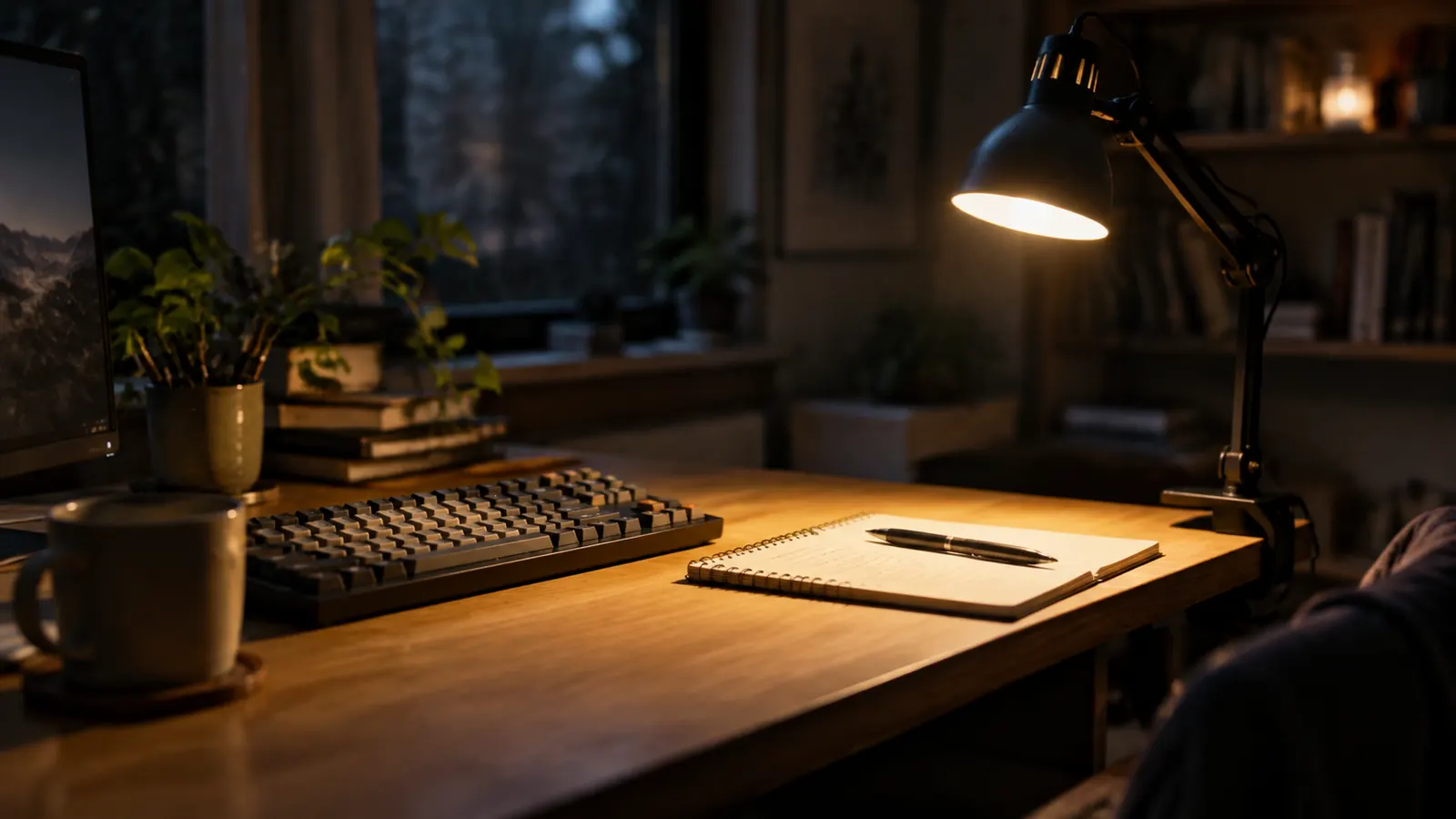
The sharpest limitation is the size of the light pool. This is a task light, and it never pretends otherwise. When I read a document on the far side of the desk, I either pull my chair toward the beam or I lean into the lit area. Because the lamp is clamped, I cannot drag it around like a portable lamp. It lives where I put it.
It is also not a call light. For video meetings, I want even light on my face, and a small lamp from the side makes one side of my face brighter than the other. During calls I keep it off and rely on the north window plus the overhead. The lamp is excellent for the hours of writing that make up most of my day, but it was not designed to light a person for a camera.
And I wish the product copy drew a clearer line between a task light and a room light. A 5 watt LED is genuinely enough for close reading, but only close. If you want a lamp that lights the whole desk for someone working at the far edge, or one that replaces a 60 watt fixture overhead, this is not it. The lamp has a purpose, and the purpose is compact directional work.
What I Liked
- No base; the clamp leaves the desktop clear
- Even pool of light at the work surface
- Clamp holds firmly on a flat exposed desk edge
- Small 5 watt LED is enough at reading distance
- Head keeps its angle after adjustment
Where It Falls Short
- Needs a clean, flat, exposed desk edge
- Clamp means no quick repositioning
- Cord can clutter the front of open desks
- Light pool is too narrow for whole-desk work
- Not flattering as a video call light
Once I moved the Lepro to the far left corner and aimed it at the keyboard, the overhead fixture stopped being part of my writing day.
Who This Is For
This lamp is for someone who works in one spot for hours and is tired of an overhead light glaring off the monitor. It is also for anyone with a small desk and no room for a lamp base, and for people who mostly read print, write in notebooks, or type in the same place every day. If you write, edit, study, or pay bills at a desk, the tight pool of light is a feature rather than a limitation.
It is especially for people whose desk has a clean front edge and whose work surface is the only surface they use. You do not need to light the whole room when the rest of the room is background. A clamp lamp solves the problem at the point of work and leaves the rest of the room dark when you want it dark.
If you are deciding between this and a floor lamp, ask yourself how often you stand up to move your lamp. I almost never do. The lamp stays at the same desk all day, so a fixed mount is not a cost; it is a feature. The only time I miss a movable lamp is when I take a laptop to the kitchen table, and a kitchen table is not part of my office routine.
When I work with a paper manual, the clamp lamp has one more advantage: it keeps the book out of the glare. I put the manual on a small stand to the left, aim the beam at it, and keep the monitor dark enough to read. The head is simple to adjust, and after months I have not felt the need for presets or a touch panel.
Who Should Skip It
Skip it if your desk has a rounded edge, a thick apron, or shelves that block every exposed edge. Skip it if you need even light across a wide work surface, or if you host video calls from a dim room and want the lamp to make you look awake. A 460 lumen task light is the wrong tool for all three of those jobs.
Skip it also if you hate cords in view. The lamp has a cord, and on many desks that cord runs down the front. If you cannot tuck it, clip it, or run it along a desk leg, it will annoy you every day. That is not a criticism of the lamp. It is the honest reason you should consider a battery-powered lamp or a floor lamp instead.
If all this sounds like too much fuss, listen to that feeling. A desk lamp should disappear into your routine. If the clamp feels like a project, you are better off with a simple base lamp or a floor lamp. There is no wrong answer here; there is only the answer that fits how you actually work.
One final group: people who share a desk with someone else. A clamp lamp set for your height is annoying to the next person if they sit six inches taller or shorter. My desk is solo, so this is not a problem in my office. If your desk is shared, choose a lamp on a flexible stand that either person can grab and move.
The Bottom Line
After months of daily use, this lamp has a permanent place on the front edge of my desk. It does not fix every lighting problem in the room, but it fixes the one that mattered most: the glare that made my monitor hard to read after lunch. It does it with no base, no bulk, and no cord running across my keyboard. The clamp is the catch, and the clamp is also the solution. If your desk edge is flat and exposed, this is a genuinely easy recommendation.
My advice is to measure the desk edge, picture the cord, and decide whether you can live with a light that belongs to one spot. That honest assessment will tell you more than any photo of the lamp on a styled shelf.
A Small Lamp With a Real Point of View
The Lepro has been in daily use in my office for long enough that I stopped noticing it, which is exactly what a task light should do. If your only problem with your desk is the overhead light, the clamp mounting is worth the small learning curve. Check today's price on Amazon and see whether your desk edge is ready for it.
Amazon Check Today's Price on Amazon →